|
|
Intravir is a drug used for the treatment of HIV. Intravir is
a non-nucleoside reverse transcriptase inhibitor (NNRTIs). Unlike
the currently available agents in the class, resistance to other
NNRTIs does not seem to confer resistance to Intravir.
Indications and dosage
Intravir, in combination with other anti-retrovirals, is indicated
for the treatment of human immunodeficiency virus type 1 (HIV-1)
infection in antiretroviral treatment-experienced adult patients,
who have evidence of viral replication and HIV-1 strains resistant
to a non-nucleoside reverse transcriptase inhibitor (NNRTI) and
other antiretroviral agents.
The recommended dose of Intravir is 200 mg (two 100 mg tablets)
taken twice daily following a meal. The type of food does not
affect the exposure to Intravir.
General Information
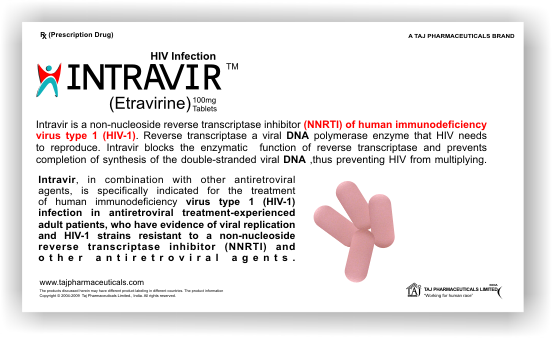
Intravir is a non-nucleoside reverse transcriptase inhibitor (NNRTI)
of human immunodeficiency virus type 1 (HIV-1). Reverse
transcriptase a viral DNA polymerase enzyme that HIV needs to
reproduce. Intravir blocks the enzymatic function of reverse
transcriptase and prevents completion of synthesis of the
double-stranded viral DNA ,thus preventing HIV from multiplying.
Intravir, in combination with other antiretroviral agents, is
specifically indicated for the treatment of human immunodeficiency
virus type 1 (HIV-1) infection in antiretroviral
treatment-experienced adult patients, who have evidence of viral
replication and HIV-1 strains resistant to a non-nucleoside
reverse transcriptase inhibitor (NNRTI) and other antiretroviral
agents.
Intravir is supplied as a tablet designed for oral administration.
The recommended initial dose of the drug is 200 mg (two 100 mg
tablets) taken twice daily following a meal. If a patient is
unable to swallow a tablet whole, it may be dispersed in a glass
of water.
Clinical Results
FDA Approval
FDA approval of Intravir was based on pooled 24-week results of
two ongoing, identical phase III trials. These randomized,
double-blinded, placebo-controlled studies were dubbed DUET-1
(TMC125-C206) and DUET-2 (TMC125-C216). The trials were designed
to evaluate the safety and antiretroviral activity of Intravir in
combination with a background regimen (BR) as compared to placebo
in combination with a BR. Randomization was stratified by the
intended use of enfuvirtide (ENF) in the BR, previous use of
darunavir/ritonavir (DRV/rtv), and screening viral load. All study
subjects received DRV/rtv as part of their BR, and at least two
other investigator-selected antiretroviral drugs (N[t]RTIs with or
without ENF. The endpoint was virologic response, defined as
undetectable viral load (< 50 HIV-1 RNA copies/mL) at 24 weeks. At
Week 24, 74% of Intellence-treated subjects achieved HIV-1 RNA <
400 copies/mL as compared to 51.5% of placebo-treated subjects.
The mean decrease in plasma HIV-1 RNA from baseline to Week 24 was
-2.37 log10 copies/mL for Intravir-treated subjects and -1.68
log10 copies/mL for placebo-treated subjects. The mean CD4+ cell
count increase from baseline for Intravir-treated subjects was 81
cells/mm3 and 64 cells/mm3 for placebo-treated subjects. Of the
population who either re-used or did not use ENF, 56.7% of
Intravir-treated subjects and 32.7% of placebo-treated subjects
achieved HIV-1 RNA < 50 copies/mL. Of the study population using
ENF for the first time, 68.6% of Intravir-treated subjects and
61.3% of placebo-treated subjects achieved HIV-1 RNA < 50 copies/mL.
Side Effects
Adverse events associated with the use of Intravir may include,
but are not limited to, the following:
* Rash
* Diarrhea
* Nausea
* Fatigue
* Abdominal pain
* Peripheral neuropathy
* Hypertension
* Headache
Mechanism of Action
Intravir is a non-nucleoside reverse transcriptase inhibitor (NNRTI)
of human immunodeficiency virus type 1 (HIV-1). Intravir binds
directly to reverse transcriptase and blocks the RNA-dependent and
DNA-dependent DNA polymerase activities by causing a disruption of
the enzyme's catalytic site. Intravir does not inhibit the human
DNA polymerases alpha, beta, and gamma.
Important Safety Information
Intravir does not cure HIV infection or AIDS, and does not prevent
passing HIV to others.
* Severe skin rash has been reported with Intravir;
Stevens-Johnson Syndrome has been rarely (<0.1 percent) reported.
Treatment with Intravir should be discontinued if severe rash
develops. In general, rash was mild to moderate, occurred
primarily in the second week of therapy, and was infrequent after
Week 4. Rash generally resolved within 1-2 weeks on continued
therapy. Discontinuation rate due to rash was 2 percent.
* No dose adjustment is required in patients with mild or moderate
hepatic impairment (Child-Pugh Class A or B). The pharmacokinetics
of Intravir have not been studied in patients with severe hepatic
impairment (Child-Pugh Class C). Therefore, Intravir should be
used with caution in patients with severe hepatic impairment.
* Based upon the safety profile, no dose adjustment is necessary
in patients co-infected with hepatitis B and/or C virus.
* Redistribution and/or accumulation of body fat have been
observed in patients receiving. ARV therapy. The causal
relationship, mechanism, and long-term consequences of these
events have not been established.
* Immune reconstitution syndrome has been reported in patients
treated with ARV therapy, including Intravir.
* The most frequently reported adverse events (>10 percent) of any
intensity that occurred at a higher rate than placebo were rash
(17 percent), diarrhoea (15 percent) and nausea (13.9 percent).
Presentation
Cadrol
Tablets
Blister of 10 Tablets
|
|



 Quality